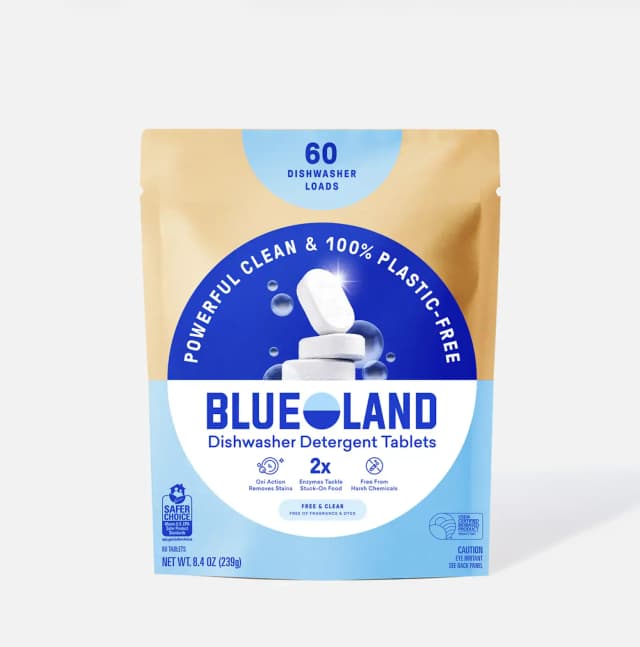
Blueland Dishwasher Detergent Tablets: Packaging Design Evaluation

May 2026 · Blueland DTC + retail expansion context · Single-concept packaging evaluation against the Practical Premium Head-of-Household persona · 8 dimensions of audience response · 60-load plastic-free dishwasher tablet pouch with EPA Safer Choice + USDA Biobased certifications

Practical Premium Head-of-Household
Practical Premium Head-of-HouseholdSingle persona this concept was evaluated against

Family decision-maker, 35–55, runs the household supply system. Buys premium when premium clearly delivers — on performance, not just values. Reads ingredient labels, weighs $/load math, expects "trusted brand" cues alongside any sustainability story. Will pay $12–$18 for a dishwasher detergent if the brand convincingly says "this cleans as well as Cascade, plus it's better for my family / planet." Performance proof and family-tested cues are both higher leverage than purely emotional or aesthetic appeal.

The Brief in One Line
The Brief in One LineWhat this study answered

Will Blueland's kraft-paper + royal-blue + plastic-free pouch packaging system perform with Practical Premium Head-of-Household across 8 dimensions: shelf impact, comprehension, emotional resonance, credibility, brand fit, competitive differentiation, value perception, and purchase intent? Overall: 7.0/10. Confidence 70%. Strong DTC fit; meaningful retail expansion challenges. Two specific gaps to close before scaling beyond DTC.

Single-concept evaluation · 60-Load Dishwasher Tablet refill pouch · Royal blue branding on kraft paper · EPA Safer Choice + USDA Biobased certifications · "Oxi Action" + "2x Enzymes" performance claims

Section 1

The Concept

Concept Overview

Plastic-free 60-load dishwasher tablet pouch · Royal blue branding on kraft paper · "Oxi Action" + "2x Enzymes" performance claims · EPA Safer Choice + USDA Biobased certified

Blueland 60-load dishwasher tablet refill pouch
BRANDBlueland
FORMAT60-load refill pouch · plastic-free packaging
PERFORMANCE CLAIMSOxi Action · 2x Enzymes · Free From Harsh Chemicals
CERTIFICATIONSEPA Safer Choice · USDA Biobased
CHANNELSBlueland DTC + retail expansion (Target / Whole Foods)
PRICE BAND$12–$18 (60 loads, ~$0.20–$0.30/load)

Headline Numbers

The one-line scoreboard. Eight dimensions evaluated; overall is the equally-weighted mean. Note the unusually wide spread — from 5 (Value) to 9 (Trust) — which itself is a strategic signal.

OVERALL SCORE7.0/10Equally-weighted mean across 8 dimensions
CONFIDENCE LEVEL70% · ModStrong for DTC; concerning for retail
PEAK DIMENSION9Credibility & Trust — certifications carry the design
SOFTEST DIMENSION5Value Perception — premium price not visually justified

Performance Summary

The one-paragraph read on whether this design will perform in market

WHAT THE STUDY SAYS

This packaging will perform moderately well in DTC and face real challenges in retail expansion. The design is a credibility win — EPA + USDA certifications, ingredient transparency, and category-distinctive design language earn high marks (Trust 9, Differentiation 8, Comprehension 8). But for the Practical Premium Head-of-Household, it under-delivers on the two things that drive their conversion: performance proof and value justification. The kraft + royal-blue aesthetic reads as "trendy sustainable" to a persona who needs "trusted, family-tested, and worth the premium." The bigger issue: this design positions Blueland as a "conscious choice" rather than the "best choice that happens to be conscious" — the framing required to win this audience at scale.

Section 2

Audience Response

8-Dimension Score Profile

Bars sorted by score (high to low). Green = strong (9+), amber = solid (8), orange = monitor (7), red = address (≤6). The shape that emerges: a credibility-driven design that's missing the emotional + value proof Practical Premium Head-of-Household requires to convert.

Credibility & Trust
9/10
Immediate Comprehension
8/10
Competitive Differentiation
8/10
Visual Attention & Shelf Impact
7/10
Brand Fit & Positioning
7/10
Emotional Resonance
6/10
Purchase Intent & Conversion
6/10
Value Perception & Price Fit
5/10
READ OF THE SHAPE

The score profile is front-loaded on rational signals and back-loaded on emotional / commercial ones. The top three dimensions (Trust 9, Differentiation 8, Comprehension 8) all answer rational questions: "is this safe?" / "is this different?" / "do I understand it?" The bottom three (Emotional Resonance 6, Purchase Intent 6, Value Perception 5) answer the emotional and commercial questions this audience also needs: "does this feel made for my family?" / "will I actually buy it?" / "is it worth the money vs. Cascade?" This is the diagnostic in one sentence: rational case is built; emotional and value case is not.

Detailed Dimension Findings

Eight cards, one per dimension. Each shows what's working (drivers of the score) and what's missing (the upside still on the table).

Visual Attention & Shelf Impact7/10
WHAT WORKS

Strong contrast between royal blue branding and kraft paper background creates immediate differentiation from typical bright, colorful detergent packaging · Clean, uncluttered design stands out against category norms of busy claim-heavy packs · The "60 DISHWASHER LOADS" callout at top provides clear value communication

WHAT GETS IGNORED / MISSED

The tablet illustration lacks the dynamic "action" visuals this audience expects from cleaning products · At small sizes, the multiple certification logos blur together · The kraft paper texture may read as "generic" or "store brand" at distance · No clear "premium" visual cues that justify higher price

Immediate Comprehension8/10
WHAT THE AUDIENCE READS INSTANTLY

Eco-friendly dishwasher detergent that's plastic-free and comes in tablet form · They immediately understand it's a 60-load supply and that it's positioned as a cleaner, more sustainable alternative

FRICTION POINTS

The "Refill" concept isn't immediately clear from front panel — this audience needs to understand the system · The relationship between "100% plastic-free" and the pouch format may create durability questions · "2x Enzymes" claim lacks context (2x compared to what?)

Emotional Resonance6/10
WHAT THE DESIGN EVOKES

"Responsible choice" and "clean conscience" — mild positive association with environmental values · Strong with the eco-aligned subset of the persona

ALIGNMENT GAPS

Aesthetic feels more "millennial eco-conscious" than "practical family decision-maker" · Missing emotional cues around family protection, reliability, and proven performance · Tone reads "trendy sustainable" rather than "trusted premium" — the latter is what motivates this persona's purchase

Credibility & Trust9/10
TRUST BUILDERS

EPA Safer Choice certification provides strong third-party validation · USDA Biobased adds government credibility · Clear ingredient transparency ("Free From Harsh Chemicals") · Specific performance claims ("Oxi Action," "2x Enzymes")

SKEPTICISM TRIGGERS

The "startup brand" aesthetic may create questions about longevity and product support · Lack of established brand-heritage cues (decades-old reputation) that this audience reflexively values

Brand Fit & Positioning7/10
HOW THE BRAND READS

Newer, mission-driven brand focused on sustainable cleaning solutions · Packaging successfully communicates environmental responsibility and product innovation

POSITIONING ALIGNMENT RISKS

Successfully differentiates from traditional brands and signals premium through design restraint and certifications · But may be too "niche sustainable" for broader retail success with this audience · The design doesn't yet make Blueland feel like a brand for "all families" rather than "eco families"

Competitive Differentiation8/10
WHERE IT DIFFERENTIATES

Completely different visual approach from Cascade, Finish, or other major brands · The kraft paper aesthetic immediately signals "different category" · Plastic-free positioning is unique in the dishwasher detergent space

SIMILARITY RISKS

Looks similar to other "clean" household brands (Method, Seventh Generation) — risk of being grouped in shopper's mind rather than standing alone · The minimalist approach may blend with store brands in some retail contexts

Value Perception & Price Fit5/10
ACCEPTABLE PRICE BAND

$12–$18 for 60 loads — persona positions this as premium-but-not-luxury · The 60-load count is doing the most work here

VALUE PERCEPTION ISSUES

Packaging doesn't clearly communicate why it's worth more than conventional options · Missing performance proof to justify premium pricing · The refill concept may create confusion about total cost of ownership · The lowest dimension score — and the most actionable

Purchase Intent & Conversion6/10
CONVERSION DRIVERS

Clear load count and value proposition · Strong environmental credentials appeal to values-aligned subset · Professional, trustworthy appearance

PRIMARY BLOCKERS

Uncertainty about performance compared to trusted brands · Questions about the refill system and long-term convenience · Lack of "family-tested" or "proven results" messaging — the persona needs at least one of these signals to commit at premium price

Section 3

Strategic Synthesis

Key Drivers of Success

The five forces doing the most work in this design's positive performance — ranked by leverage on the overall persona response.

#DRIVERWHY IT WORKS
1Credibility through certificationsEPA Safer Choice and USDA Biobased provide the third-party validation Practical Premium Head-of-Household reflexively requires from any brand asking for premium pricing. Drives the 9/10 Trust score directly.
2Clear value communication"60 LOADS" prominently displayed addresses the practical decision-maker's first question: "how much do I get?" Without it, the design's value perception score would be even lower.
3Category differentiationThe kraft + royal-blue system stands out completely from the bright, claim-heavy Cascade / Finish / Tide aesthetic that dominates the shelf. This is half of why Differentiation scores 8/10.
4Premium aestheticClean design and material restraint suggest quality and attention to detail. The design refuses to shout, which feels confident — though it leaves performance proof unsaid.
5Transparency"Free From Harsh Chemicals" + visible ingredient cues build trust. This is exactly the kind of label-reading reward Practical Premium Head-of-Household actively looks for.

Primary Risks & Barriers

The five headwinds holding this design back from a stronger overall score. Two are addressable through design changes; three require strategic decisions.

#RISKWHY IT MATTERSSEVERITY
1Performance anxietyThe packaging lacks visual or textual proof that Blueland cleans as well as trusted brands. For a Cascade-conditioned audience, "Oxi Action" + "2x Enzymes" without a "vs. leading brand" or family-tested cue isn't enough proof to commit.High
2Price justification weaknessPremium positioning isn't visually supported by obvious benefits. The kraft + minimalist design is a negative proof point at price — the absence of premium visual cues works against the price.High
3System complexity (refill)The refill concept isn't clearly explained on front panel, creating adoption friction. Practical Premium Head-of-Household wants the system to make sense in the 5 seconds of shelf attention.Medium
4Family relevance gapMessaging doesn't address family-specific concerns (kid messes, busy schedules, multi-generational use). Reads as designed for an individual eco-buyer, not a household decision-maker.Medium
5Retail shelf invisibilityThe pastel kraft palette risks getting lost among more aggressive, colorful competitors in mass retail. DTC strength does not translate cleanly to the Target / Walmart / Costco shelf.High in retail

Positioning Implications

The single biggest strategic finding from this study — and what it means for Blueland's expansion path.

THE POSITIONING SHIFT THIS STUDY POINTS TO

The current packaging positions Blueland as a "conscious choice" brand — a values-led alternative to conventional detergents. This works for the eco-aligned subset of Practical Premium Head-of-Household. But for the broader segment, the design needs to shift toward "best choice that happens to be conscious." That's not a tone change — it's a hierarchy change. Performance + family relevance need to lead; sustainability becomes the supporting story. This is the central strategic implication of the 5/10 Value Perception and 6/10 Purchase Intent scores.

WHERE THIS PLAYBOOK CAN STRETCH

The brand's certification stack (EPA + USDA + clean ingredient story) is genuinely defensible and supports an entire refill-system platform across categories: hand soap, laundry, multi-surface, glass, bath. The design system — once it adds performance proof — is repeatable across the full Blueland category map.

WHERE IT WILL STRUGGLE

This system does not work in mass retail (Target / Walmart / Costco) without channel-specific adaptation. Practical Premium Head-of-Household at the Costco end-cap is a different shopper than at Blueland.com — less patient, more price-conscious, more reliant on visual shouting to identify the right product. A retail-specific package variant is the single biggest commercial decision this study points to.

Section 4

Optimization & Go-to-Market

Design Optimization Recommendations

Three buckets of changes — design, messaging, and structure — that target the four soft dimensions (Emotional Resonance 6, Purchase Intent 6, Value Perception 5, Visual Attention 7) without disturbing what's already working at 8–9.

DESIGNAdd performance + premium cues
  • · Add performance imagery: cleaning-action visuals, before/after, sparkle cues that this audience reads as "it actually cleans"
  • · Strengthen premium signals: subtle texture, foil accents, or other quality indicators — combat the "store brand" risk at distance
  • · Improve hierarchy: make key benefits more prominent than certifications
  • · Add subtle family-context visual cues: a small icon or photo treatment that signals household use
MESSAGINGLead with performance & quantify
  • · Lead with performance: move cleaning claims higher in the visual hierarchy than certifications
  • · Clarify refill value: add messaging about convenience and cost savings ("save vs. buying 4 boxes / 2 lb plastic / etc.")
  • · Add social proof: "trusted by 100,000+ families" or similar credibility marker
  • · Quantify benefits: replace "2x Enzymes" with a specific comparison ("vs. our v1 formula" or "vs. leading conventional")
STRUCTUREChannel-aware structural moves
  • · Consider a dual-panel approach: front for performance, back for sustainability story
  • · Enhance load-count visibility: make "60 LOADS" even more prominent — it's already the strongest practical signal
  • · Add usage guidance: brief instructions for the refill system on the front panel to address the comprehension gap
  • · Develop a retail-specific package variant — see channel split below

DTC vs Retail Channel Split

The central commercial finding: this design is built for DTC and breaks down in mass retail. Two different shoppers, two different design briefs.

CHANNELFORECASTKEY CONSIDERATION
Blueland DTCStrong — ship as-is. Detailed product pages can address performance questions. Subscription model aligns naturally with refill concept.Direct customer education via FAQ, video demos, founder-story content. Pricing transparency on-site builds value perception.
Whole Foods / specialtySolid — the kraft + minimalist aesthetic reads correctly to the eco-aligned shopper who self-selects to specialty grocery.Shelf talker with cert stack visible. Cross-merchandise with other Blueland SKUs to build system awareness.
Target / mass retailConcerning — needs stronger shelf presence against established brands. Deeper color saturation and larger performance claims required.Develop a retail-specific package variant with performance leading and sustainability supporting.
Costco / clubAt risk — the kraft palette risks reading as "store brand" against bold national-brand competitors at the end-cap.Multi-pack format with quantified vs.-leading-brand claims and family-tested marker.

Net Verdict

FINAL READ
Where this design wins outright

Trust (9), Differentiation (8), Comprehension (8). The rational case is well-built — certifications, ingredient transparency, and a category-distinctive design language all earn their keep with Practical Premium Head-of-Household.

Where the design needs lift

Value Perception (5), Purchase Intent (6), Emotional Resonance (6). All three answer the same question this audience repeats: "is this worth more than Cascade, and will it actually clean?" Adding performance imagery + quantified benefit + family-context cue is the brief.

The channel decision

DTC: ship as-is. Mass retail: requires a retail-specific variant with performance leading and sustainability supporting. This is the single biggest commercial implication of the study.

Recommendation: ship for DTC, build a retail-specific variant. The 9 on Trust is rare and valuable — preserve it. The 5 on Value is the most actionable single fix and lifts most cleanly with performance imagery + quantified comparison. The retail variant is the bigger commercial bet — without it, expansion beyond DTC + specialty grocery will hit a hard ceiling. Confidence: 70%. Conditional ship.

RUN YOUR REPORT

Want a category review for your home-care line?

Run a Gutsy study against AI-lookalike audiences for your category. Same depth, your own products.

Methodology & Caveats

Study design. Single-concept packaging evaluation conducted via Gutsy persona scoring against the Practical Premium Head-of-Household persona. Eight dimensions evaluated on a 0–10 scale: visual attention & shelf impact, immediate comprehension, emotional resonance, credibility & trust, brand fit & positioning, competitive context & differentiation, value perception & price fit, purchase intent & conversion. Each dimension was scored with supporting drivers and missed-opportunity rationales.

Persona basis. Practical Premium Head-of-Household represents the family-decision-maker (35–55) who runs household supply systems and rewards premium pricing only when premium clearly delivers on performance + family relevance. This persona reflexively requires third-party validation (cert stacks, established brand cues), needs visual proof of efficacy (cleaning action imagery, quantified comparisons), and is more value-anchored than aesthetic-driven.

What the study covers. Visual / cognitive / emotional response to the packaging system as photographed (front panel + side panel, refill pouch format). Channel performance forecasts across Blueland DTC, mass retail (Target / Costco / Walmart), and specialty grocery (Whole Foods). Strategic implications for retail expansion and adjacent SKU extension.

What the study does not cover. In-use product performance (formulation efficacy, cleaning power, scent, residue, dishwasher compatibility). Cross-persona response (single-persona evaluation; broader audiences would require additional persona scoring). Specific competitor SKU benchmarking with side-by-side packshots. Sales / sell-through forecasting.

Scoring caveats. The 7.0/10 overall is the equally-weighted mean of the 8 dimensions. In practice, Purchase Intent and Value Perception carry more leverage on actual conversion than the unweighted average suggests — a focused weighting model would push the headline overall closer to 6.6–6.8, reinforcing the "conditional ship" recommendation. Treat the 7.0 as the optimistic read.

Generated by Gutsy · May 2026Blueland Dishwasher Detergent Tablets — Packaging Design Evaluation
Powered by Gutsygutsy.so